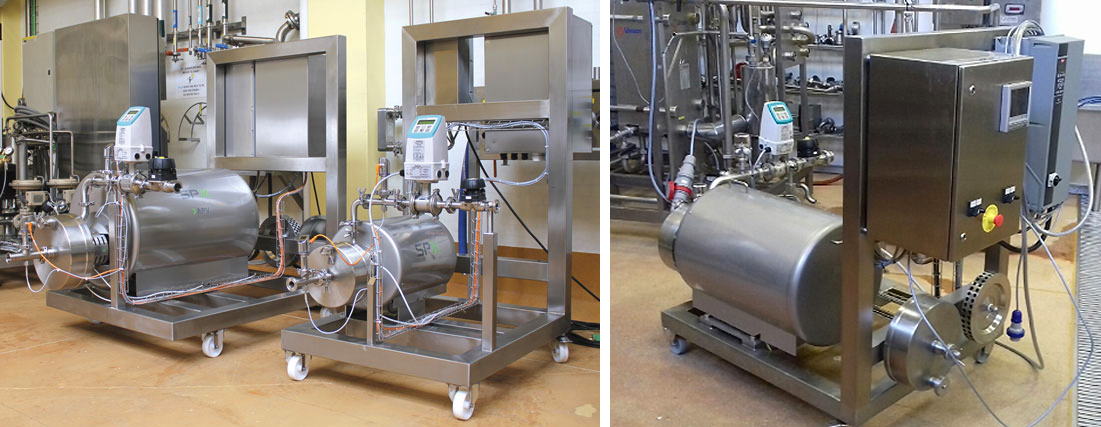
The powerful forces generated by cavitation produce results that greatly surpass those achieved by conventional technology.
The APV Cavitator represents a breakthrough in achieving highly efficient microscopic mixing and scale-free heating through controlled hydrodynamic cavitation.
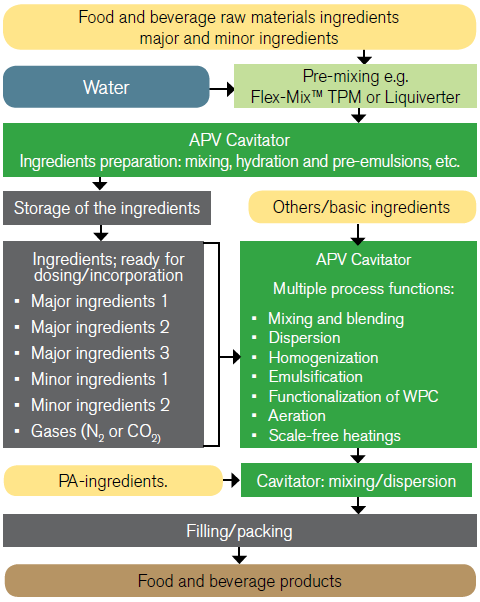
The food and beverage processing can typically be divided into three main steps. The first step involves the preparation of raw materials and ingredients, which includes hydration, functionalisation, and pre-emulsification. The second step focuses on the main processing activities, such as mixing, blending, and the incorporation of base raw materials and ingredients. This is often followed by dispersion, homogenization, emulsification, and usually thermal treatment. The final step involves mixing and blending through the dispersion of post-additions (PA) of minor ingredients and possibly gases for aerated or carbonated products.
Key challenges in any food and beverage process include maximising product quality, optimising raw material yields, and ensuring plant uptime. There is also the need to minimise process cycles, clean-in-place (CIP) time, and overall production costs. In this regard, the APV Cavitator offers a wide range of benefits that align with the needs of the food and beverage industry, providing solutions that enhance efficiency and performance.
The Principle of the APV Cavitator
The core of the technology involves a rotor that spins within a liquid chamber. This rotor features several radial holes. As it spins, it creates internal liquid friction (referred to as disk friction), while the holes generate hydrodynamic cavitation. This cavitation leads to high shear forces, resulting in a highly efficient microscopic mixing effect and friction that generates controllable, scale-free heating.
 Use of the APV Cavitator in Food and Beverage Processing
The process diagram outlines the typical steps involved, from ingredient preparation to the main processing stages, with functions culminating in the final addition of PA ingredients and, possibly, gas dispersion.
Regardless of the type of food or beverage products being produced, many of the processes described will be included either as standalone steps or in combination. Thanks to the multifunctional capabilities of the APV Cavitator, it can fulfil all the process functions illustrated in the diagram.
Commercial installations in the food and beverage sectors as well as in personal care have demonstrated the advantages of using Cavitator technology to enhance product quality and financial performance. Additional application tests conducted at the SPX FLOW Innovation Centre and at customer sites have uncovered its versatility, showing that it can be utilised across a broad range of applications and products in the food and beverage industries, including:
- Liquid egg products
- Ice cream mix
- Dairy and food products
- Powdered ingredients
- Processed and fine foods
- Nutritional beverages, carbonated drinks, and beer
- Meat, poultry, seafood, and pet food
- Fresh dairy products, yogurt, and desserts
- Bakery and confectionery items
Features and Benefits of the APV Cavitator in Food and Beverage Production
The APV Cavitator utilises controlled hydrodynamic cavitation technology, which has been successfully applied in the processing of liquid eggs, meat and pet food, as well as personal care products like toothpaste and body wash. This technology offers unique features and benefits for a variety of food and beverage applications:
- Microscopic Mixing: The excellent mixing of gums and proteins allows for quick hydration, leading to product savings, shorter processing cycles, increased uptime, and lower operating expenses.
- Preemulsions and Homogenisation: Using the Cavitator for preemulsions, in conjunction with high-pressure homogenization, can significantly enhance product quality while reducing the need for high pressures and multiple passes.
- Microparticulation of WPC: The functionalization of whey protein concentrate (WPC) through the microparticulation process results in a precise particle size distribution of 1μ, improving water binding, emulsification properties, and providing a creamier taste.
- Superior Dispersion Capability: The Cavitator excels in achieving homogeneous mixing of minor ingredients in viscous products, which enhances the overall appearance and quality of the products.
- Efficient Emulsification: It delivers high-quality emulsification for products like mayonnaise and dressings, as well as the recombination of dairy protein and butter.
- Temperature Control: The Cavitator operates without a heat transfer surface, preventing the formation of hot or cold spots. This feature makes it suitable for heat-sensitive products such as liquid eggs, whey proteins, puddings, cheese, and BBQ sauces. It results in longer run times and fewer clean-in-place (CIP) cycles, while the gentle heating preserves the functional properties of proteins.
- Gas Distribution: The Cavitator effectively disperses gas media such as N2 or CO2, ensuring uniform gas distribution in foamed mousse products or carbonated beverages.
- Sanitary Design: Its highly reliable and sanitary design meets 3-A and EHEDG standards.
- Low Maintenance: The Cavitator requires minimal maintenance, further contributing to reduced operating expenses.
- Flexible Delivery Options: The APV Cavitator can be provided either as a standalone unit or as a plug-and-play skid-mounted system.
Overall, the APV Cavitator is an innovative solution that enhances efficiency and quality in food and beverage production. For more information on the APV Cavitators and pump solutions range, contact Dynapumps.
📞 Call us Australia-wide: 1300 788 579
📧 Email our team: sales@dynapumps.com.au
🌐 Visit our website: www.dynapumps.com.au